
Lemhi
After more than three years of service supporting advanced research and computational workloads, the Falcon supercomputer was officially retired on December 19, 2025. During its operational lifetime, Falcon played a key role in enabling data-intensive analysis, modeling, and discovery across a wide range of projects. Falcon is being replaced by the Lemhi supercomputer, a more modern system designed to deliver consistent performance to meet the evolving computational needs of researchers and programs moving forward.

Lemhi Beginnings
Lemhi was purchased in 2018 by Idaho National Laboratory. Lemhi is a 504 node Dell C6420 cluster. Each node has dual Intel Xeon Gold 6148 20 core processors running at 2.4GHz. For a total of 20,160 cores. Each node has 192GB of RAM as well. In November 2018, Lemhi was ranked 427 on the top500 list of supercomputers. Lemhi comes in with a theoretical performance of 1.55 PetaFlops offering a modest improvment over its predecessor Falcon (theoretical peak of 1.17 PetaFlops).
Current Status
In April of 2025, INL turned the hardware over to University of Idaho, Boise State University, and Idaho State University to run collaboratively for university research. The supercomputer has been rebuilt using Rocky Linux 8.10 on the compute nodes. The dual Xeon Gold 6148 processors in each node are packaged with 192 GB of RAM to complete RAM intensive jobs. In order to tackle some big data problems, Omni-Path is used to connect the Falcon nodes to one another as well as a 1.3 PB Lustre parallel file system used for storage and scratch space.
Lemhi News & Projects
No posts
Falcon (Legacy)
Falcon Supercomputer
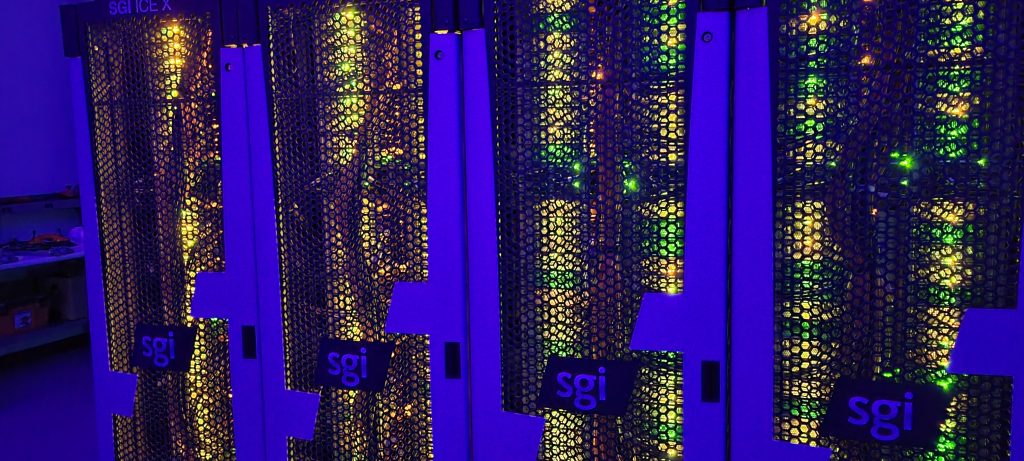
Falcon is an SGI ICE X supercomputer currently operated and used by a consortium of Idaho research universities (University of Idaho, Boise State University, Idaho State University). Falcon is owned by Idaho National Laboratory (INL) and ranked 97th on the Top 500 list of the world’s fastest supercomputers when it was operationalized in 2014 and significantly upgraded in 2017. Through a Memorandum of Understanding (January 2022), management and use of Falcon was transferred to the Idaho research computing consortium.
Falcon currently consists of approximately 932 nodes with dual Intel Xeon E5-2695v4 18-core processors running at 2.1 GHz (36 cores per node) for a total of 33,552 cores capable of more than 1 PetaFLOPS of compute capacity. Each node on Falcon is configured with 128 GB of RAM for a total of about 120TB of overall system memory, uses an Infiniband-based interconnect configured as a 7-dimensional hypercube, and uses a 1.3 petabyte fault-tolerant Lustre filesystem.
Faculty, staff, and students from the three Idaho universities access Falcon free of charge. Falcon is connected to the universities via the Idaho Regional Optical Network (IRON) which enables high speed data transfers to both local and remote compute centers.



Idaho C3+3 Collaboration. (2022). Falcon: High Performance Supercomputer. University of Idaho. https://doi.org/10.7923/falcon.id